
Revolutionary Road
It could be about a war with a title like this and indeed it is about a war that exists behind closed doors – the combatants are a young husband and his wife, who supposedly have it all.
April and Frank live on Revolutionary Road, a quiet beautiful street in an affluent suburb filled with other young couples and they seemingly have it all – a comfortable home, gorgeous small children, money, and work. April is a stay at home Mum who plays house and Frank has a job with prospects of advancement up the ranks. But appearances can be deceptive and all is not what it seems.
The book of Ecclesiastes paints a similar picture of life: “meaningless! Meaningless! Utterly meaningless! Everything is meaningless.” (Ecc 1:2) The writer looks at different ways of trying to find meaning in life – seeking after wisdom, or the pleasures of life, or through work, or by gathering wealth, and concludes that none of these things will provide meaningful fulfilment.
It is Frank’s birthday and he tries to drown his unhappiness and emptiness by spending the day with a beautiful girl he has met through work and drinking himself insensible and then seducing her. He returns home to a wife who is making one final effort at restoring the magic that was in their relationship at the beginning.
During the day, April came across a photo of Frank from his youth in front of the Eiffel Tower in Paris. She remembers a conversation in which his face lit up with excitement as he described the wonder of Paris. She thinks if they return to Paris, he might rediscover this joy and exuberance. April convinces Frank that they can sell their home, he can leave his job and go and live in Paris – she can work, while he “finds himself” whatever that is. There is an element of a “chasing after the wind” in this move but they are determined to give it a go and the question is, will this tactic work? Will they be able to replace the fighting words and vicious attacks and salvage what is lost from their relationship?
April and Frank are a personification of what happens to many couples in our world today. They meet, fall in love and start their married life with a dream of what their life will become.
Before long, the monotony and reality of the patterns of life begin to wear them down. They become disappointed with what their life becomes, and that they have been replaced by shattered dreams. Most of the time, they are tired and worn down and are wondering what happened to their shared dreams. It has become empty and hopeless and they begin to take their unhappiness out on each other and their home is filled with fighting and verbal attacks. The love they had for each other is replaced by contempt and loathing.
Revolutionary Road is set in America in the 1950s and the book of Ecclesiastes was written centuries ago, but both are equally relevant to Sydney in 2009. An acquaintance went to see Revolutionary Road and left in floods of tears and said it described her home. How sad is that?
The film ends without hope and the people’s lives are still empty. Not one of the characters has figured out how to make the monotony and rhythms of life any different. God makes no appearance in this film and it is almost in His absence that He is patently there. It is only with God that hopelessness can be replaced with hope and emptiness replaced by a deep contentment.
If Revolutionary Road is a confronting film for Christian couples, there is a possibility of change and reconciliation. You don’t have to remain in the war zone; you can call a truce and seek peace. You can be the one to begin to treat the other differently. It won’t happen overnight but is possible to retreat, think and pray and ask that God will transform the relationship into one that is spirit-filled and brings delight to His name.
Tuesday, February 3, 2009
Revolutionary Road

Wednesday, November 19, 2008
Ely and beyond
A week has passed and this has been my first opportunity to put pen to paper - or fingers to keyboard. We are sitting in Hong Kong Airport, waiting to board our flight. So much has happened.
On our final day in Bury, Keith and I decided to drive over to Ely to explore the Cathedral and see where Oliver Cromwell lived. It was a glorious final day to be in England. Not a cloud in the sky, and it was almost balmy in temperature. Ely Cathedral is set upon a hill and it stands among the fels - tall and majestic and visible for miles. The late afternoon sunlight made the cathedral sparkle. It is a Normal building that is austere and plain inside. I loved the floors with its simple green and red marble floor. There were floors with rustic quirky paving stones. The ceilings and stained glass windows were majestic. The simplicity of the building allows the colours from the windows to dominate and shine. We enjoyed wandering around and found the burial place of a bishop who had met with Ricky and engaged in vigorous debate - both disagreeing with one another.
We then went and wandered past the home of Oliver Cromwell. Outside there is a seat with Mrs Cromwell's favourite recipe for Roast Eel. I decided to pass on jotting it down. We drove back to Bury watching the sun set. The colours were soft and muted and seemed to capture the soft light we had experienced during our time in England.
We had a final dinner out with Susan and Ricky who treated us to a feast. It was a fitting final evening after a wonderful week staying with them - we shared so many stories and laughter and fun. It was a truly memorable visit. We were up at 5am the next morning to drive to Heathrow.
We watched the sunrise this time and it was a beautiful way to leave England. Twelve hours later we arrived in Hong Kong to bright warm sunshine, heat, freeways, bridges, noise, highrise towers in overstated abundance, people and people and colour. It was a completely overwhelming arrival and felt like we had moved from the fridge into a simmering wok. We found our Hotel - the YMCA which is located right on the harbour at Kowloon. My friend Melinda met us there a couple of hours after our arrival. What a joyful and happy reunion we shared!
We set off in our coolest clothes and sunglasses and caught the ferry across to the Island and then walked up to the cable car to travel to the Peak. The glorious weather had followed us and Hong Kong was fairly clear. The assent was steep and I wanted to keep my eyes closed, but refrained as the view was spectacular.
Hong Kong may be densely populated and have more high rise buildings in a smaller space than anywhere else in the world, but its harbour and mountains seems to give it an air of order and beauty. We walked beneath tall trees that gave us a sense of coolness. I couldn't get over the walkways that join places and buildings. We were able to walk from the harbour to the cable car - at least one km, and not cross a single busy road.
Once at the top, we sat and marvelled at the view, the size of this city and the number of people who inhabit and visit this tiny space. We sat and talked and talked and laughed and talked some more. We haven't seen Melinda for two years, so it was good to catch up on her life and her family.
We watched the sun setting over the ocean, visited the Dymocks bookstore and browsed and finally had dinner at a Japanese restaurant overlooking the harbour. The outlook was glorious - Hong Kong at night is almost magic with the lights and different colours on the buildings. We felt we had arrived in a tropical hot pot of vibrant colour. My brain felt overstimulated and I longed for bed.
On our final day in Bury, Keith and I decided to drive over to Ely to explore the Cathedral and see where Oliver Cromwell lived. It was a glorious final day to be in England. Not a cloud in the sky, and it was almost balmy in temperature. Ely Cathedral is set upon a hill and it stands among the fels - tall and majestic and visible for miles. The late afternoon sunlight made the cathedral sparkle. It is a Normal building that is austere and plain inside. I loved the floors with its simple green and red marble floor. There were floors with rustic quirky paving stones. The ceilings and stained glass windows were majestic. The simplicity of the building allows the colours from the windows to dominate and shine. We enjoyed wandering around and found the burial place of a bishop who had met with Ricky and engaged in vigorous debate - both disagreeing with one another.
We then went and wandered past the home of Oliver Cromwell. Outside there is a seat with Mrs Cromwell's favourite recipe for Roast Eel. I decided to pass on jotting it down. We drove back to Bury watching the sun set. The colours were soft and muted and seemed to capture the soft light we had experienced during our time in England.
We had a final dinner out with Susan and Ricky who treated us to a feast. It was a fitting final evening after a wonderful week staying with them - we shared so many stories and laughter and fun. It was a truly memorable visit. We were up at 5am the next morning to drive to Heathrow.
We watched the sunrise this time and it was a beautiful way to leave England. Twelve hours later we arrived in Hong Kong to bright warm sunshine, heat, freeways, bridges, noise, highrise towers in overstated abundance, people and people and colour. It was a completely overwhelming arrival and felt like we had moved from the fridge into a simmering wok. We found our Hotel - the YMCA which is located right on the harbour at Kowloon. My friend Melinda met us there a couple of hours after our arrival. What a joyful and happy reunion we shared!
We set off in our coolest clothes and sunglasses and caught the ferry across to the Island and then walked up to the cable car to travel to the Peak. The glorious weather had followed us and Hong Kong was fairly clear. The assent was steep and I wanted to keep my eyes closed, but refrained as the view was spectacular.
Hong Kong may be densely populated and have more high rise buildings in a smaller space than anywhere else in the world, but its harbour and mountains seems to give it an air of order and beauty. We walked beneath tall trees that gave us a sense of coolness. I couldn't get over the walkways that join places and buildings. We were able to walk from the harbour to the cable car - at least one km, and not cross a single busy road.
Once at the top, we sat and marvelled at the view, the size of this city and the number of people who inhabit and visit this tiny space. We sat and talked and talked and laughed and talked some more. We haven't seen Melinda for two years, so it was good to catch up on her life and her family.
We watched the sun setting over the ocean, visited the Dymocks bookstore and browsed and finally had dinner at a Japanese restaurant overlooking the harbour. The outlook was glorious - Hong Kong at night is almost magic with the lights and different colours on the buildings. We felt we had arrived in a tropical hot pot of vibrant colour. My brain felt overstimulated and I longed for bed.
Tuesday, November 11, 2008
Winter is here
During the week we have been in Bury, we have watched the leaves fall from the trees and vanish - they are raked away to leave the trees and ground bare and wintery.
We have not had marvellous weather here - yesterday it rained all day. We were a little anxious about whether our visas and passports would arrive. This morning they were delivered by special delivery - much to our relief and for Ricky and Susan who were wondering if we would be stuck here.
Last Saturday we met Susan and Ricky in Cambridge for lunch and then saw the play by Alan Bennett "Enjoy". It was set in 1980 and a dark comedy, but most enjoyable.
We have been travelling by bus to Cambridge through Newmarket, much to my excitement, as I have read all of Dick Francis' books, many of which are set in and around Newmarket. We drove past the flats where the horses are exercised, many trainer's yards and homes and two statues of Hyperion - the most famous horse in history.
It is a delightful meander which takes about an hour. Imagine driving along country roads on a double decker bus! The driver generally travels at a high speed.
It has been a delight to watch autumn mature. We arrived in England just as the leaves were losing their summer finery and now they are becoming bare - in readiness for the long winter. The squirrels are busy storing nuts by burying them deep in the ground - they are a nuisance, but they are certainly very cute!
We have not had marvellous weather here - yesterday it rained all day. We were a little anxious about whether our visas and passports would arrive. This morning they were delivered by special delivery - much to our relief and for Ricky and Susan who were wondering if we would be stuck here.
Last Saturday we met Susan and Ricky in Cambridge for lunch and then saw the play by Alan Bennett "Enjoy". It was set in 1980 and a dark comedy, but most enjoyable.
We have been travelling by bus to Cambridge through Newmarket, much to my excitement, as I have read all of Dick Francis' books, many of which are set in and around Newmarket. We drove past the flats where the horses are exercised, many trainer's yards and homes and two statues of Hyperion - the most famous horse in history.
It is a delightful meander which takes about an hour. Imagine driving along country roads on a double decker bus! The driver generally travels at a high speed.
It has been a delight to watch autumn mature. We arrived in England just as the leaves were losing their summer finery and now they are becoming bare - in readiness for the long winter. The squirrels are busy storing nuts by burying them deep in the ground - they are a nuisance, but they are certainly very cute!
Thursday, November 6, 2008
Bury St Edmunds


We were sad to leave our friends behind - we had such a wonderful time with them. We flew from Dublin to Gatwick and were greeted by grey drizzle which we drove through on the M25 around London, to Bury St Edmunds which is a town close to Cambridge.
My aunt lives here with her husband and we arrived in the late afternoon in time for a cup of tea. They have just moved into this house, which is incredible. It is built into the ruins of the Abbey which fell into disrepair during Henry VIII's reign. At that time, it was the largest Abbey in Europe. There is now a cathedral and the most beautiful gardens around the ruins which are open to the public. There is a wall of houses beside the Cathedral which is where their house is.
It is really the most amazing place to live. It is four storeys, and the top floor has been labelled the grotto by Susan, as there is this cave like wall that cannot be touched and the house has been built around it. Next to the front door is a wall, and behind this is the kitchen, but the wall is fourteen feet thick!
It was dark on our arrival and in the morning, when I looked out of our bedroom window, this is the view:

I have been fighting a cold this week and the weather is not exactly enticing for the tourist. But it has been fun to lie low and pretend that I live here in style. Yesterday we had a mad panic realising that we had to apply for visas for China and needed to do this now, rather than on our arrival in Hong Kong, which is what our travel agent had advised. The rules had changed on November 1st. We had to pay a fortune to get it done via an organisiation in London, who do the leg work for you, but it removes the angst and hopefully, they will arrive by post on Monday, with our passports! The Chinese Embassy is just around the corner from where we were staying in London - silly me!
My cousin by name visited yesterday who I had not seen for thirty years. We had such fun together and reminsced about our teenage exploits and the fun we had had together in Sydney in 1978. She now has a thirteen year old son who is autistic and is his full time carer - so she had a 24 hour break which we managed to fill with eating, shopping, talking and laughing endlessly.
Keith went into Cambridge by bus and registered to use the library and spent the remainder of the day there. He has returned there today and Susan and Ricky have left us alone for two nights - they have gone up to Cambridge together. I think this is my first afternoon and evening alone and I am about to cook dinner on the Aga and a quiet night in.
It is nice not to be a tourist and just be domestic. I think that Susan and Ricky are hoping that we don't burn their house down in their absence.
Tomorrow I am going into Cambridge with Keith to meet up with Gerald Bray and Marty Forde.
Sunday, November 2, 2008
Sugarloaf Mountain and Black Pudding

Yesterday there about nine things that Jane wanted to do with us. We realised our time here is drawing to a close and there was not enough time to fit them all in. As the sun was shining, we decided to climb Sugarloaf Mountain that lies to the south of Shankhill, which is where Ed and Jane live.
It is a spectacular looking hill and we were assured there were wonderful views from the top. We were not disappointed. It is really a scramble up to the top - you pull yourself up. The sun shone and we could see snow on the Wicklow hills in the distance.

After enjoying the views, we scrambled down and drove on the Sallygap Road to a place where there were spectacular views to a hidden lake. The countryside had this raw, bleak beauty that is incredibly appealing. It is a two hour return walk, and with all the other things we wanted to do, we decided we would have to do this walk "next time".

Once home, Ed cooked us all bacon and eggs with black pudding. It was surprisingly good and we enjoyed it immensely. Jane was determined to get us to taste this during our time here, so we did.
Later that afternoon, we went to see the latest James Bond movie that had just come out and thoroughly enjoyed it. There is every chase imaginable and there is a constant adrenalin rush through the entire film. Keith didn't think it was as good as Casino Royale, but I thought it was great.
We then went out to dinner with some friends from Crinken church - and had a wonderful evening and a delicious meal. The Irish are warm and friendly and great fun. They were as interested in us as we were in them - it was a late night talking in front of a fire. Later, Ed drove us home past Bono's home, not that we could see much,as it is gated and surrounded by a high wall.
Saturday, November 1, 2008
Snippets of history

During our time with Ed and Jane, we have been soaking up Irish history. I knew very little about how the Republic of Ireland evolved and why Ireland is divided into north and south, and have little understanding of the religious and political tensions that have created the Ireland of today. A couple of nights ago we watched the film "Michael Collins" about one of the leaders of the uprising and eventual civil war during the 1920s. I was intrigued. Earlier this week, Ed and Jane took us to where the Battle of the Boyne took place in 1690 - a different period of time, but equally significant.
I have also learnt about the potato famine which almost halved the population in size and despite pleas to the English for help, none was received. We found out that most of the trees of Ireland were removed centuries ago by the English to build Naval ships - ships such as those we saw at Portsmouth several weeks ago - the Victory, the Mary Rose and the Warrior. Poverty, hunger and cold were the bleak reality for most Irish people.
Ed's father grew up about six kilometres from the Cliffs of Moher during the 1920s and never visited them. The expression "you can't eat a view" was the reality of their life. Most of the children had no shoes and having felt the cold you would have permanent frozen ice blocks for feet and would not choose to walk anywhere.
Ed's grandfather's name was John O'Halloran and he grew up in Tulla - east Clare. Keith has just discovered that one of his distant ancestors was John Halloran who grew up in Dooniss - not far from there! The O was often dropped off in Irish names. Keith's ancestor made his way to Australia during the potato famine in 1855. What an amazing coincidence. There is a genealogical centre in Clare and if we had known this information before going, we might have been able to trace these two John's to see if there was any connection. Next time.
As it was, we had plenty to keep us busy. We were keen to visit the place where Niall Williams has settled with his wife Chris Breen in 1985. I have been reading their delightful book "O Come Ye Back to Ireland: Our first year in County Clare" during our time here and enjoyed it immensely. They settled in a place called Kiltumper which is not on the map but is close to the village of Kilmihil. On arriving there, Jane went into the post office to ask for directions to Kiltumper. "And who would you be looking for there?" she was asked. On explaining that we were Australians and just wanted to go there, she was asked "would you be looking for the Williamses?" She was given very Irish directions "well you see this road? you go down this road a while and you go past the school and then you go and you come to a bend in the road to the left. At the point of the bend there is a road and this is where you go. You will then go past a house, then another house and then there is a lull and then you are there."
We followed these directions and found their house, but didn't want to intrude - we just peeked over the hedge. Their first summer had been very wet I felt like I had been there with them as they adjusted to their new life away from New York. It is an insightful look at Irish life and the friendliness and warmth of the people as well as the harsh realities of the land and making ends meet.
They had described a monument in Kilmihil erected in the 1920s commemorating Sean Brean who had been shot during the uprising. So we returned to Kilmihil to find it. Nothing jumped out at us and we found ourselves in the Catholic cemetery when a woman walked in, who we stopped to ask if she could tell us where it could be found. In the way of the Irish, we engaged in a delightful conversation with her and found out all sorts of things but nothing about any monument, as she is fairly new to the area - her late husband was from here and was now buried in this cemetery and she daily visited him.
She suggested we ask at the post office, which we were reluctant to do, as we had already been there. We could already imagine the gossip of the village - these four Australian's looking for the Williamses and a monument. Fortunately, we stumbled across it by accident - in the book, it was outside the community hall which is now the public library. It is a beautiful celtic cross and diagonally across the road is a stone marking the place where he was shot. Sean Breen had been involved in attempting to shoot the police as they left church one Sunday morning. The police then started shooting and threw grenades towards civilians also leaving the church, so Sean ran forward in an attempt to divert them from killing innocent people and in the process was shot himself. In the book is a letter his mother Catherine writes to her sister living in Australia expressing her angst but also pride in her son's actions. A tiny village and a tiny snippet of history, but somehow it seemed to make the reality of the uprising and civil war more real to each of us.


We had a most untypical Irish day - clear blue skies without cloud. We headed for the coast - a place called Spanish Point. We walked along a flat beach in the brisk cold and enjoyed the sun and sea. Again, this place has a history - this time of a Spanish ship retreating during the Spanish Amarda that hit the rocks and sank. The crew survived and spent the remainder of their lives here - thus explaining the dark skin and hair of some of the locals.


After driving along a part of the coast that was spectacular, we had lunch in a village at a pub - another vegetable soup which was green this time - so Jane and I had fun identifying the vegetables, we headed back for Dublin. A long drive without snow and with wonderful views of the countryside clothed with autumn splendour that turned golden in the setting sun.
West coast county Clare
We set off on Wednesday for the wild west coast of Ireland. This is where Ed's father grew up in a tiny coastal village. It is also where Niall Williams lives and writes is evocative books which we have all read and enjoyed. We drove through a snow storm heading west. it was so white we wondered if it might be wise to turn back and head home.
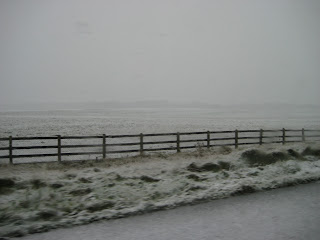
Towards late afternoon we arrived in Ennis where we were to stay for two nights. The snow had eventually turned to rain, but it was cold, bleak and windy. We walked around the town looking for pubs where we might eat and hear some traditional Irish music. Keith bought me a CD of Declan O'Rourke and chatted with the guy in the shop who assured us there were at least four pubs that served "very nice meals" and had music. We found one, that proudly displayed a sign "live music tonight at 9pm". This is where we did eat and waited for the music. At around 9.45, we asked the owner when the music would be starting and he told us they didn't do live music on Wednesday's. This seems to capture something of the Irish, where you don't find out the full truth about anything - yes, we have live music but not tonight.
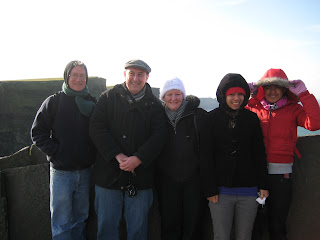
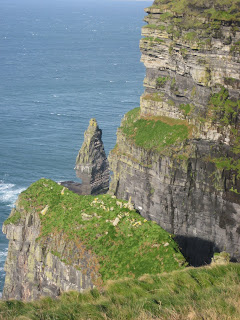
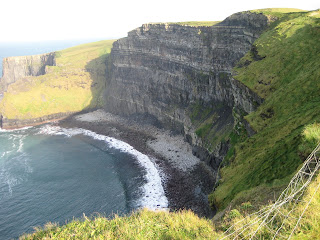
We awoke to a clear blue sky and drove to the Cliffs of Moher. These cliffs seem to arise out of no where - they soar 200 metres above the sky. Despite the sun, it was bitterly cold and we tried to rug up as warmly as we could. We made a dash for the cliffs from the car and enjoyed the spectacular views across to the Aran Islands, and up and down the coast and then down to the sea. This is a place of bleak beauty - but it was almost too cold to stand and appreciate. We headed back to the car and drank cups of coffee in the warmth before driving north up the coast towards Black Head.
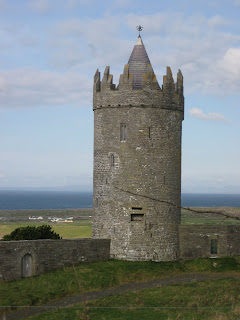
There are these castles dotted around the country side that are crumbling down, but dominate the local landscape.

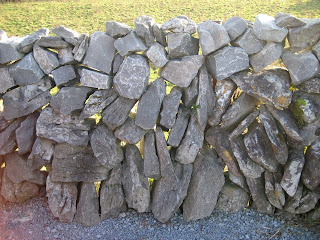
The colours of the rocks, sea and grass blend to an irish quilt of greys and greens waiting to be made back home. I love the rocky walls - these stones have been put together like a jigsaw puzzle and are then overgrown with gorse and bracken. In the spring time, Jane tells me that the gorse flowers bright yellow - this must be an amazing sight. I am enjoying the autumn colours, but at this place there are no trees and the landscape is barren and bare.

We decide to head towards a perfumery in the Burren National Park in a village called Corofin where they have a cafe. The countryside is gorgeous and it seems like we are driving forever along windy narrow roads with few signposts and there is an uncertainty that we will reach this spot on the map.
We stop firstly to see a dolmen. This is an ancient portal tomb that dates back to the Neolithic period, 3200BC. We are amazed that this structure has stood the test of time - the winds, the rain, the blizzards and the gales.

On arriving, we discover that the cafe is open during summer only - we can only laugh as it has taken us so long to get there. The pub in Corofin had looked inviting, with beautiful views across a loch. We arrive to discover it is closed to the public as there is a private function on. By this time is is 3.30, so we load ourselves into the car to in the hopes of eventually finding a pub that will find us. We are finally revived with soup and brown soda bread - an Irish staple that is delicious - as was the vegetable soup, that looked like pumpkin, but was probably mostly carrot and potato and warmed us to the core.
That evening we were treated to wonderful Irish music at a different pub. The pub is where the locals meet their friends and chat and socialise. County Clare is a gorgeous spot and we feel we have merely glimpsed what is on offer. Tomorrow we will do more exploring.

Towards late afternoon we arrived in Ennis where we were to stay for two nights. The snow had eventually turned to rain, but it was cold, bleak and windy. We walked around the town looking for pubs where we might eat and hear some traditional Irish music. Keith bought me a CD of Declan O'Rourke and chatted with the guy in the shop who assured us there were at least four pubs that served "very nice meals" and had music. We found one, that proudly displayed a sign "live music tonight at 9pm". This is where we did eat and waited for the music. At around 9.45, we asked the owner when the music would be starting and he told us they didn't do live music on Wednesday's. This seems to capture something of the Irish, where you don't find out the full truth about anything - yes, we have live music but not tonight.
We awoke to a clear blue sky and drove to the Cliffs of Moher. These cliffs seem to arise out of no where - they soar 200 metres above the sky. Despite the sun, it was bitterly cold and we tried to rug up as warmly as we could. We made a dash for the cliffs from the car and enjoyed the spectacular views across to the Aran Islands, and up and down the coast and then down to the sea. This is a place of bleak beauty - but it was almost too cold to stand and appreciate. We headed back to the car and drank cups of coffee in the warmth before driving north up the coast towards Black Head.


There are these castles dotted around the country side that are crumbling down, but dominate the local landscape.


The colours of the rocks, sea and grass blend to an irish quilt of greys and greens waiting to be made back home. I love the rocky walls - these stones have been put together like a jigsaw puzzle and are then overgrown with gorse and bracken. In the spring time, Jane tells me that the gorse flowers bright yellow - this must be an amazing sight. I am enjoying the autumn colours, but at this place there are no trees and the landscape is barren and bare.

We decide to head towards a perfumery in the Burren National Park in a village called Corofin where they have a cafe. The countryside is gorgeous and it seems like we are driving forever along windy narrow roads with few signposts and there is an uncertainty that we will reach this spot on the map.
We stop firstly to see a dolmen. This is an ancient portal tomb that dates back to the Neolithic period, 3200BC. We are amazed that this structure has stood the test of time - the winds, the rain, the blizzards and the gales.


On arriving, we discover that the cafe is open during summer only - we can only laugh as it has taken us so long to get there. The pub in Corofin had looked inviting, with beautiful views across a loch. We arrive to discover it is closed to the public as there is a private function on. By this time is is 3.30, so we load ourselves into the car to in the hopes of eventually finding a pub that will find us. We are finally revived with soup and brown soda bread - an Irish staple that is delicious - as was the vegetable soup, that looked like pumpkin, but was probably mostly carrot and potato and warmed us to the core.
That evening we were treated to wonderful Irish music at a different pub. The pub is where the locals meet their friends and chat and socialise. County Clare is a gorgeous spot and we feel we have merely glimpsed what is on offer. Tomorrow we will do more exploring.
Subscribe to:
Posts (Atom)
